Francais
 Cart
Cart Quote
QuoteStainless steel 201, 304, 316: Which steel should you choose for your professional kitchen?
In the restaurant industry, the choice of materials is never insignificant. Between strict health standards, intensive cleaning, constant humidity, and the frenetic pace of service, equipment is subjected to major mechanical and chemical stresses.
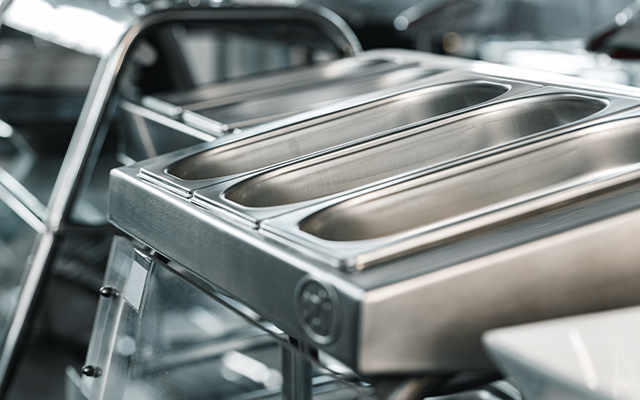
While stainless steel has established itself as the absolute standard in professional kitchens, the generic term "stainless" actually covers several grades with very unequal performance. 201, 304, or 316 stainless steel: how do you navigate the differences? Which one should you choose to guarantee the compliance, durability, and profitability of your establishment?
Technical breakdown to help you make the right choice at Lobrot.
What is food-grade stainless steel in the food service industry?
To be qualified as "food-grade" and authorized for direct contact with food, stainless steel must meet current European standards. In a professional kitchen, this material is not an option; it is a necessity to meet four fundamental requirements:
- Organoleptic neutrality: No transfer of taste, smell, or substance to food (zero chemical migration).
- Corrosion resistance: It must withstand water, food acids (lemon, tomato), and salt.
- Perfect hygiene: Its smooth, non-porous surface prevents bacteria and mold from attaching.
- Cleanability: It must withstand frequent disinfection protocols without deteriorating.
The secret to resistance: passivation
Why doesn't stainless steel rust? Thanks to the chromium present in its alloy (at least 10.5%). Upon contact with oxygen, chromium forms an invisible protective layer called the "passive layer." If you scratch your worktop, this layer spontaneously reforms, "healing" the metal. It is this self-protection that makes stainless steel indispensable in professional environments.
The 3 stainless steel grades to know (and their real-world uses)
Not all stainless steels are equal when facing the harshness of a kitchen. Here are the concrete differences between the three market standards.
1. 201 Stainless Steel: The budget-friendly alternative
201 stainless steel is an austenitic steel where part of the nickel is replaced by manganese.
- Its assets: It offers a good visual appearance, good shock resistance, and above all, a very competitive price.
- Its limits: Its corrosion resistance is lower. It is sensitive to stagnant water and chlorinated products.
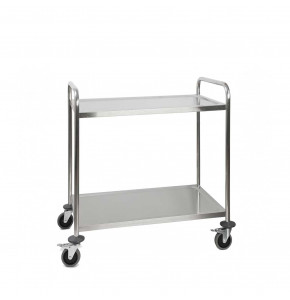
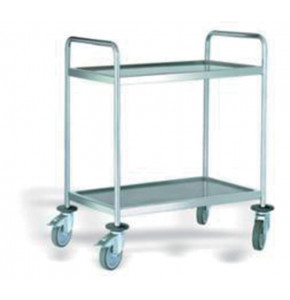
- For what use? It is ideal for dining room furniture, service trolleys, or dry zone storage equipment.
- Lobrot's advice: 201 stainless steel is a smart choice to optimize the budget, provided it is kept away from washing areas and constant humidity.
2. 304 Stainless Steel: The "Gold" standard of professional kitchens
This is the absolute reference (often called 18/10 for 18% chromium and 10% nickel). It represents the best technical balance.
- Its assets: Excellent corrosion resistance, perfectly inert to food, compliant with the strictest HACCP standards.
- Its limits: More expensive than 201, it can still suffer in very saline environments (seaside).
- For what use? Everywhere. Preparation tables, sinks, low cabinets, wall shelves, cookware.
- The verdict: For a standard professional kitchen, 304 stainless steel is the investment in safety and longevity.
3. 316 Stainless Steel: The fortress for extreme environments
The addition of molybdenum (2 to 3%) in its composition changes the game. It is often referred to as "marine grade" stainless steel.
- Its assets: Exceptional resistance to chlorides, aggressive detergents, and saline environments.
- Its limits: Its high cost.
- For what use? Indispensable for seaside establishments, fishmongers, or central kitchens using very powerful industrial cleaning processes.
Quick comparison table
| Criteria | 201 Stainless | 304 Stainless | 316 Stainless |
|---|---|---|---|
| Food Contact | ⚠️ (Conditional) | ✅ Yes | ✅ Yes |
| Humidity Resistance | ⭐⭐ | ⭐⭐⭐⭐ | ⭐⭐⭐⭐⭐ |
| Acid/Salt Resistance | ⭐ | ⭐⭐⭐⭐⭐ | ⭐⭐⭐⭐⭐ |
| Acquisition Cost | € | €€ | €€€ |
| Recommended Use | Trolleys, dry storage | Pro Kitchen Standard | Seaside, Intensive Lab |
The Buying Guide: Which one to choose for your establishment?
Do not choose your stainless steel at random. A wrong choice can lead to premature corrosion, refusal of compliance during a health inspection, and avoidable replacement costs.
- Are you equipping a dry store or a dispatch area? 201 Stainless is often sufficient and helps reduce the overall bill.
- Are you equipping the production zone (hot/cold) and the dishwashing area? Take no risks: opt for 304 Stainless. It is the durability standard for your tables and sinks.
- Is your restaurant on the seafront or do you process many iodine-rich products? 316 Stainless is imperative to avoid rust spots due to salty air.
Maintenance: The mistake you must never make
Even the best 316 stainless steel can be damaged if poorly maintained. One golden rule prevails in all professional kitchens: Ban bleach and metal sponges.
Chlorinated products (Bleach) attack the passivation layer, creating irreversible rust spots, particularly on 201 and 304 stainless steel.
The best practice: Cleaning with hot water and a mild professional detergent/degreaser, followed by abundant rinsing and, ideally, drying with a soft cloth.
Stainless steel is not just an aesthetic finish; it is the guarantor of your hygiene and your work tool. At Lobrot , we select our equipment to meet the reality of your trade. Choosing the right grade means investing in the serenity of your services for years to come.