Francais
 Cart
Cart Quote
QuoteThe FIFO method: The cornerstone of efficient and economical stock management
When managing a warehouse, workshop or medical supply room, the way in which products enter and leave the shelves determines the profitability of your supply chain. Among the various management strategies, FIFO (First In, First Out) stands out as the gold standard for guaranteeing product quality and limiting financial losses.

What is FIFO? Why is it essential beyond the food sector? And most importantly, how can storage furniture help automate this practice? Let’s break it down.
FIFO (First In, First Out): Definition
The acronym FIFO stands for "First In, First Out". In French, it is referred to as PEPS ("Premier Entré, Premier Sorti").
The principle is simple: the products that have been in storage the longest should be the first to be picked and shipped (or used). Practically, this means maintaining a strict stock rotation where new arrivals are placed behind or beneath existing items, creating a natural flow.
This method contrasts with LIFO (Last In, First Out), often used for non-perishable materials or bulk storage, but which carries a higher risk of obsolescence.
Why FIFO is Critical for Your Business
While FIFO is vital in the food industry for obvious safety reasons, it is equally essential in manufacturing, pharmaceuticals, and general logistics. Here’s why:
Reduce Obsolescence and Waste
This is the number one benefit. Whether storing chemical reagents with expiration dates, moisture-sensitive electronic components, or products whose packaging can age (collect dust, fade), FIFO ensures that the items delivered are always safe and compliant. It prevents "dead stock" from sitting at the back of a shelf and ending up discarded.
Smooth Stock Valuation
During periods of inflation, purchase prices fluctuate. FIFO enables clearer accounting by using older stock first, ensuring that remaining inventory reflects more accurately the current market value.
Ensure Consistent Product Quality
By systematically shipping the oldest (but still valid) items first, you maintain uniform quality. This avoids situations where a customer receives a “fresh” product one week and a “six-month-old” product the next.
How to Implement an Effective FIFO System
FIFO is not just a guideline—it requires organisation. Successful implementation relies on three pillars: identification, training, and, crucially, the right equipment.
Identification and Labelling
A clear labelling system is essential. Each stock unit (SKU) should display the receipt, manufacture, or expiration date. Barcodes or colour codes help operators quickly and visually identify the next batch to be picked.
Organisation by Product Families
Grouping similar products simplifies rotation. If references are mixed, operators waste time searching for the oldest item. Well-zoned storage areas form the foundation of an effective FIFO system.
Strategic Choice of Shelving
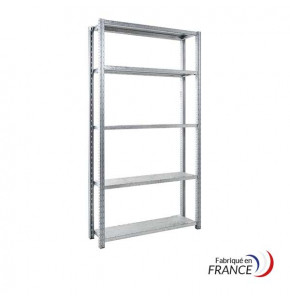
This is where logistics becomes operational. FIFO is difficult to implement with standard shelves pushed against a wall, as it forces operators to remove old products to place new ones behind them (double handling).
To automate FIFO, you should opt for appropriate storage solutions:
- Dynamic (Gravity) Shelving: The ultimate FIFO solution. Shelves are slightly inclined and equipped with rollers. Items are loaded from the top (replenishment side) and roll down to the bottom (picking side) automatically. The first item loaded is mechanically the first picked.
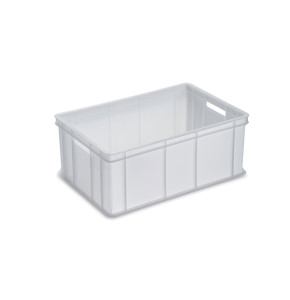
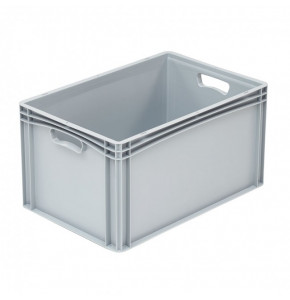
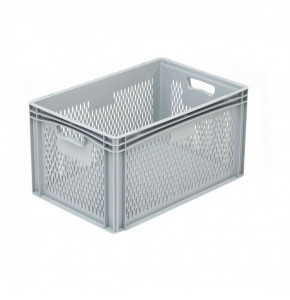
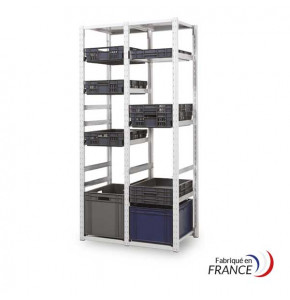
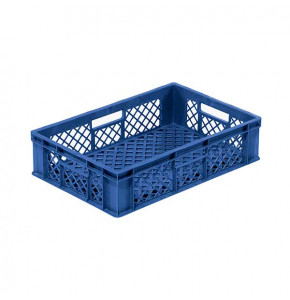
- Through Shelving (Open-Back): Ideal for Europe-standard bins (600x400 mm). The absence of a back panel or dividers allows loading from the rear and picking from the front. This separates the flows of stockers and pickers, avoids collisions, and guarantees proper rotation.
- Front-Opening Bin Systems: For small parts (screws, components), stacked bins with front openings provide constant access to contents, making visual stock checks quick and easy.
Adopting FIFO transforms a static warehouse into a dynamic flow zone. It requires discipline and team training, but the return on investment is immediate: fewer losses, reduced expired products, and optimised space utilisation.