Francais
 Cart
Cart Quote
QuoteThe guide to Gastronorm food pans
Food pans are an essential tool in any commercial kitchen, offering a versatile and efficient way to store, transport, and serve food. Designed to withstand high temperatures and resist corrosion, food pans are suitable for use in ovens, steam tables, transport racks, and cold storage.
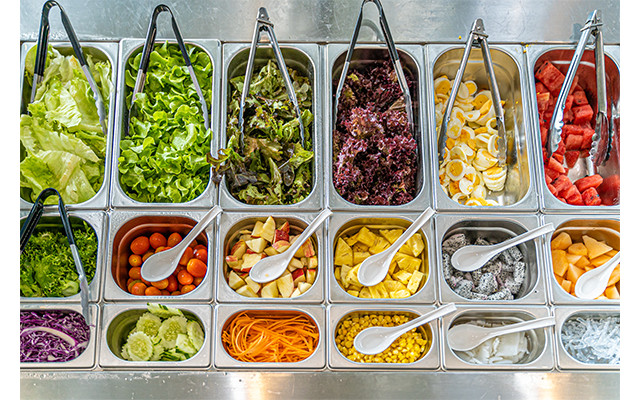
Thanks to their stackable design and compatible lids, they facilitate space organization and maximize the efficiency of your workstations. Whether you need to store ingredients, prep food, or present dishes in a display case or buffet, food pans are a must-have for any foodservice establishment.
What is the Gastronorm (GN) format?
Similar to standardized formats used in other industries, the Gastronorm (GN) format was invented to provide a global standard for pans and other kitchen equipment. The term, also known as gastronomical-normal, originated in Switzerland in 1964 and is now widely used across Europe and beyond.
The main objective of these sizes is to promote flexibility in every kitchen and allow the use or transfer of individual containers to a variety of compatible appliances (combi ovens, refrigerators, racks, display cases...).
Standard food pan sizes
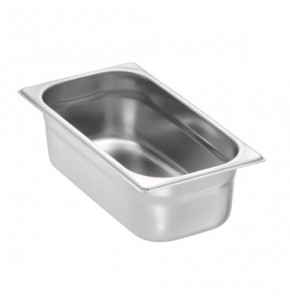
Standard size food pans (GN 1/1) are the absolute benchmark in the foodservice industry. All other pan sizes are simply fractions or multiples of these base dimensions.
Here is the official list of standard gastronorm (GN) pan sizes in millimeters:
- GN 2/1: 650 x 530 mm (Generally used for oven racks)
- GN 1/1: 530 x 325 mm (The reference size)
- GN 2/4: 530 x 162 mm (Long format)
- GN 2/3: 354 x 325 mm
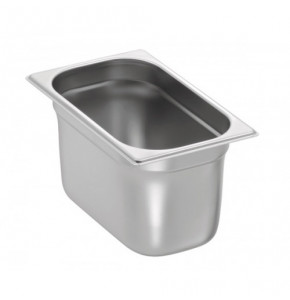
- GN 1/2: 325 x 265 mm (Half of a GN 1/1)
- GN 1/3: 325 x 176 mm
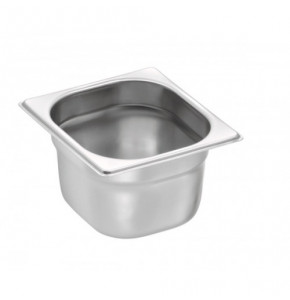
- GN 1/4: 265 x 163 mm
- GN 1/6: 176 x 162 mm
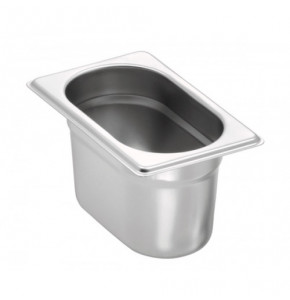
- GN 1/9: 176 x 108 mm (Ideal for small sauces or garnishes)
Depths and capacities
In addition to the pan size, depth is an equally important selection criterion. The number of portions you can store or serve depends primarily on this depth.
The most common depths for foodservice pans are: 20 mm, 40 mm, 65 mm, 100 mm, 150 mm, and 200 mm.
GN pan configurations and modularity
The true strength of the Gastronorm system lies in its perfect modularity. As you can see in our infographic below, a space designed for a GN 1/1 pan can be divided in multiple ways to accommodate several smaller pans of the same or different sizes.
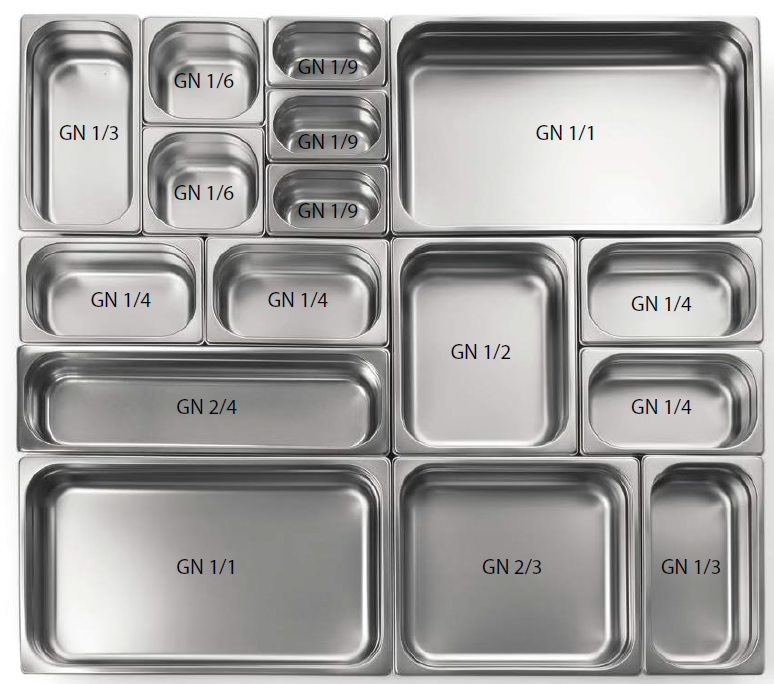 Examples of possible combinations to fill a standard GN 1/1 space.
This flexibility allows you to configure your buffets, salad bars, or steam tables exactly according to the day's menu: 2 GN 1/2 pans for two main courses, or 6 GN 1/6 pans for a garnish bar! The use of adapter bars (small stainless steel crossbars) will allow you to secure the pans together safely.
Which material should you choose for your pans? (Lobrot's Advice)
Depending on your intended use, the choice of material is crucial:
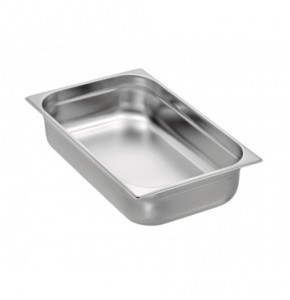
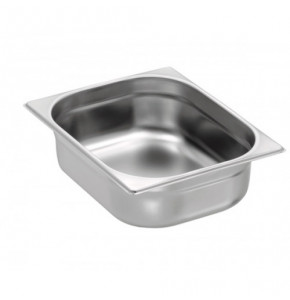
- Stainless Steel: Essential for cooking, hot-holding (steam tables), and foolproof sturdiness. It withstands extreme temperature variations.
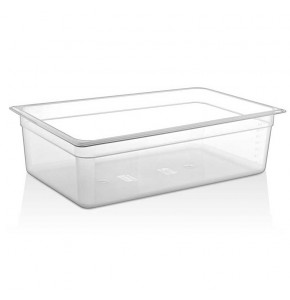
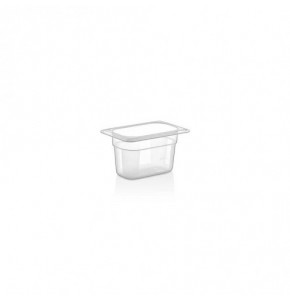
- Polycarbonate (Clear): Ideal for cold room storage. Its transparency allows for quick content identification, and it resists food acids.
- Polypropylene: The ultimate economical alternative. It is often used for dry or cold storage and is microwave-safe.
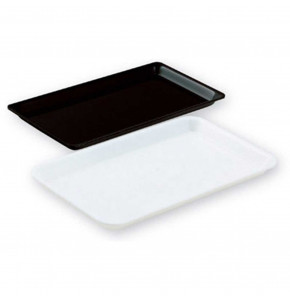
- Melamine: Perfect for buffet presentation thanks to its high-quality porcelain look and high impact resistance.
Need to equip your kitchen or optimize your storage space?
Discover our range of food pans