Francais
 Cart
Cart Quote
QuoteProfessional kitchen flooring: Ensuring safety, hygiene, and comfort with gratings
In the hospitality and foodservice sector (Cafés, Hotels, Restaurants), an establishment’s performance is not determined solely by what is on the plate. It also depends on the working environment. Slippery floors, intensive foot traffic, and stringent HACCP standards place professional kitchen flooring under constant strain. Often overlooked, the choice of floor covering is nevertheless strategic. Discover why installing technical grating systems, such as the white 500×500 mm model, has become an essential standard for demanding professionals.
Safety First: A Legal Obligation in the Face of Slip and Fall Risks
In professional kitchens, the main hazard is underfoot. According to industry statistics, same-level falls remain one of the leading causes of workplace accidents.
As an employer, your liability is directly involved. Since 2002, you have been legally required to identify and document risks in your Single Risk Assessment Document (DUER). As highlighted by L’Hôtellerie Restauration, the risk of slipping is critical: same-level falls alone account for 29% to 30% of accidents in traditional hotels and restaurants.
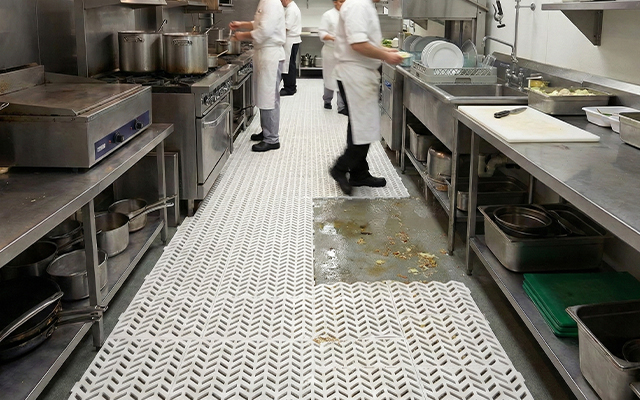
Between water splashes in the dishwashing area, oil spills, and ambient humidity, tiled floors can quickly turn into skating rinks. The solution is not limited to wearing safety footwear, but lies in managing the floor itself: effective drainage.
The 18 mm thick grating creates an essential raised surface:
- Its open-grid structure allows liquids and debris to pass immediately through the walking surface.
- Result: Your teams literally work “above” the hazard, on a surface that remains dry and provides strong mechanical grip, even during peak service.
Hygiene Control: “White” as a Strategic HACCP Choice
Why choose a white grating rather than black or grey? While aesthetics play a role, this is above all a decisive hygiene advantage for your HACCP plans.
White grating acts as a cleanliness indicator. It makes any dirt or trapped food residue instantly visible, enforcing constant cleaning discipline. In addition, the material used (high-density plastic) is:
- Rot-proof: It does not decay, even when permanently immersed.
- Chemical-resistant: It withstands alkaline degreasers and chlorine-based disinfectants used daily.
Reducing Fatigue and Musculoskeletal Disorders (MSDs)
The work of chefs and dishwashers is physically demanding. Prolonged standing on hard surfaces (concrete or tiles) for 8 to 12 hours generates shock waves that travel through the ankles, knees, and back. This is a major contributing factor to Musculoskeletal Disorders (MSDs).
Installing modular grating tiles provides an “anti-fatigue” effect. The slight flexibility of the plastic material absorbs part of the energy with each step, acting as a natural shock absorber.
Extra comfort: In cold areas (positive cold rooms, meat preparation zones), the 18 mm thickness creates an insulating air layer, blocking cold transfer from the floor to staff members’ feet.
Modularity: A Practical Solution for Existing Premises

Unlike a complete tiled floor renovation, which requires business interruption, grating installation is immediate. The 500 x 500 mm format offered by Lobrot provides full modularity:
- Custom installation: The tiles interlock to cover specific areas (in front of cooking ranges, along dishwashing stations) or entire rooms.
- Easy cleaning: The lightweight tiles can be lifted or removed section by section to clean the underlying floor with a hose or squeegee, without excessive effort.
Investing in a technical white 500x500x18 mm grating means investing in the long-term durability of your working environment. By reducing accident risks and improving staff comfort, you directly enhance service quality.