Francais
 Cart
Cart Quote
QuoteTransport and storage of food in the hospitality industry: How to choose the ideal insulated container for your business
In the restaurant, catering and institutional sectors, controlling the cold and hot chain is a key issue. Whether for table service, delivery, outdoor events or inter-site transport, storage equipment plays a key role in the final quality of the dishes. At Lobrot, specialists in catering equipment, we support professionals with reliable, durable and compliant solutions. Today we focus on two essential technologies: rigid containers for GN trays and the revolution in EPP insulated containers.
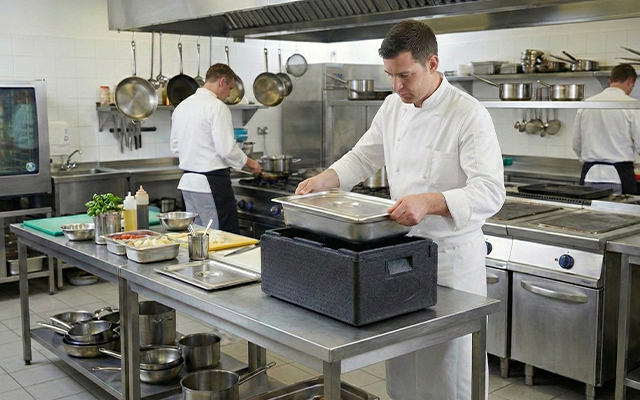
Why Use an Insulated Food Pan Carrier in Professional Catering?
An insulated container, also known as a food pan carrier, is not just a simple transport box. It is a vital link in your Food Safety Management System (FSMS) that allows you to:
- Maintain food at regulatory temperatures (hot or cold holding).
- Avoid the temperature danger zone (bacterial proliferation).
- Optimize organization in central kitchens or production laboratories.
- Ensure consistent quality right up to service.
The GN 1/1 Pan Carrier: Durability and Hygiene for Daily Use
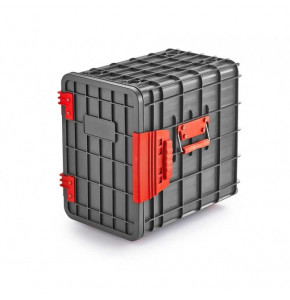
Among the solutions most used in professional settings, the container for GN 1/1 pans – 41 × 59 × 59 cm stands out as a reliable benchmark.
The GN 1/1 Pan Carrier: Durability and Hygiene for Daily Use
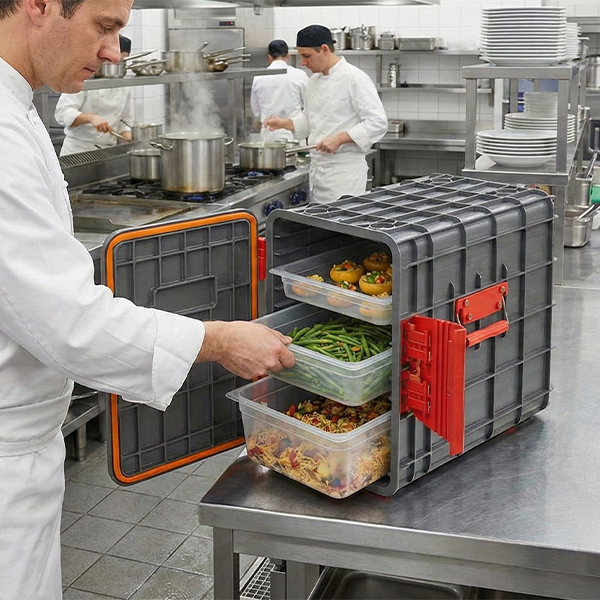
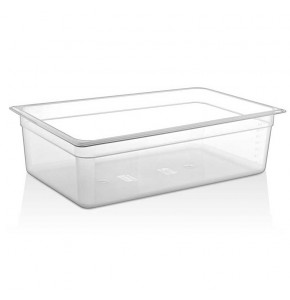
Designed to accommodate GN 1/1 Gastronorm pans, this carrier fits naturally into professional kitchens.
- Robust design for intensive use: Manufactured from high-density materials, it offers a stable structure that withstands shocks. Its reinforced and ergonomic handles make lifting heavy loads easier.
- Hygiene and food safety guaranteed: Sanitary safety is total thanks to a removable silicone gasket and a detachable hinged door. Everything is designed for easy cleaning (commercial dishwasher safe) and to prevent cross-contamination.
- Space saving and optimal organization: Stackable, it optimizes storage and transport. Its dark gray color ensures a sober and professional appearance, hiding signs of wear.
The Lobrot Expert Opinion: It is the "4x4" of food transport. A lasting investment for those who refuse to compromise on sturdiness and sealing.
The EPP Range: "Featherweight" Performance
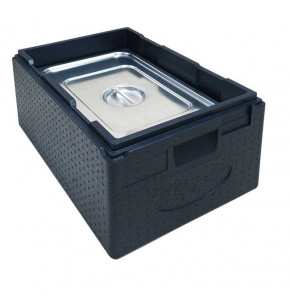
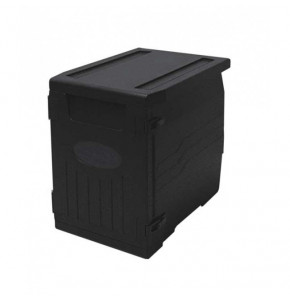
The other essential solution is Expanded Polypropylene (EPP). This technical material is appealing to more and more professionals for its exceptional weight-to-performance ratio.
A High-Performance Technical Material Meeting Foodservice Needs
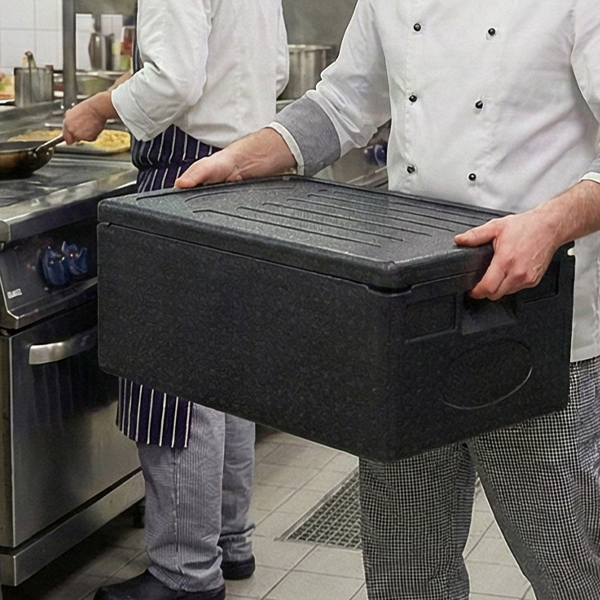
- Extended thermal conservation: Maintains from -40°C to +120°C. With a container 75% full, the loss is only 1°C to 2°C per hour.
- Lightness and resistance: Ultra-light when empty, EPP possesses "shape memory" that absorbs shocks without breaking.
- GN compatibility and versatility: Compatible with stainless steel or plastic pans, ideal for hot, cold, and frozen items.
- Stackable and easy to store: Like rigid containers, EPP models are stackable, which facilitates: storage, vehicle transport, and logistics fleet management.
Buying Guide: Criteria to Check Before Investing
To choose between these two technologies, here are the main criteria to analyze, based on international food transport standards.
Loading Type
-
Front Loading
As seen on the rigid 41 × 59 × 59 cm model.
Ideal for sliding in multiple GN pans on rails without removing everything. Preferred format for plated service and large volumes.
-
Top Loading
Often found on simple EPP boxes.
More economical and often more thermally efficient, but requires unstacking the pans.
Thermal Retention Duration
Ask yourself: how long is your transport?
- For short to medium trips ( < 4 h): a well-insulated passive container is sufficient.
- For longer durations: prioritize reinforced insulation and maximum filling.
Note: Empty space significantly accelerates thermal loss.
Mechanical Resistance
If your containers are exposed to:
- Repeated shocks
- Truck loading
- Uneven floors
A Strategic Choice for Your Performance
The right container is the one you forget about: it protects your culinary creations and facilitates the work of your logistics teams.
Whether you opt for:
- the sanitary sturdiness of the rigid container,
- or the high-performance lightness of EPP,
Lobrot has selected certified, durable equipment for you, designed for demanding professionals.